

Paper Fold
CASUAL AZUR GAMES
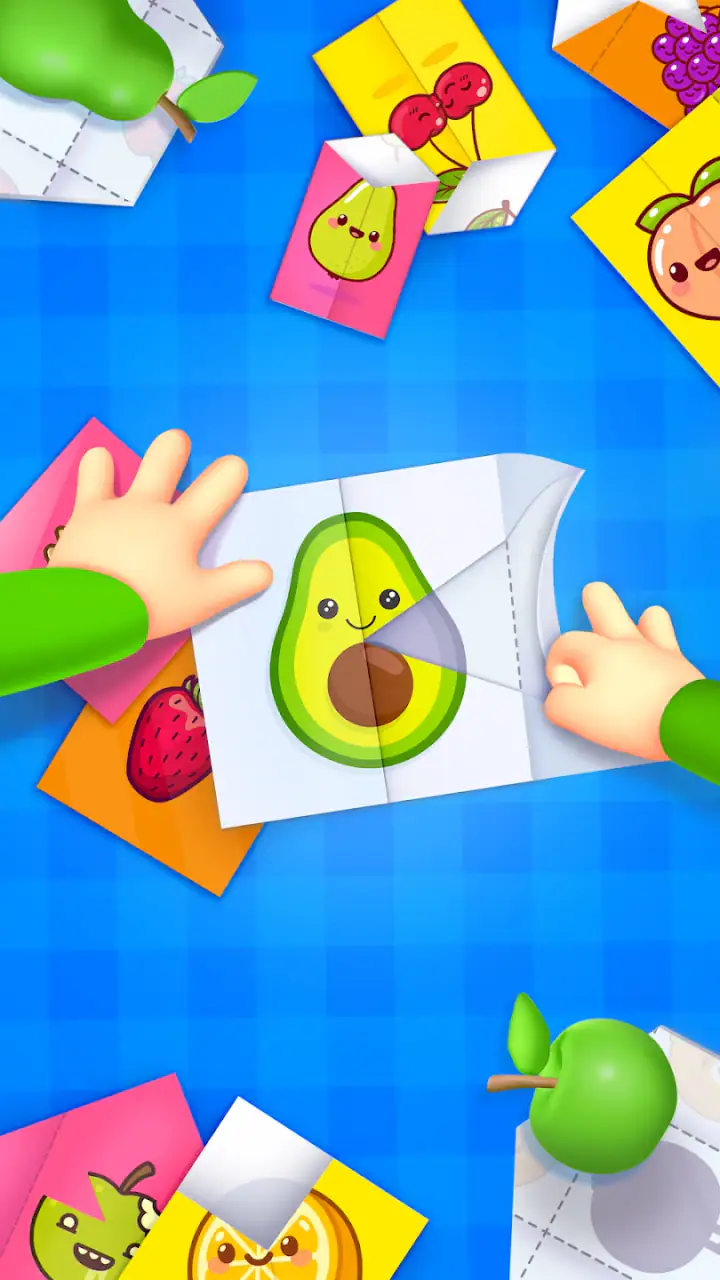
I spent time with Paper Fold as the kind of puzzle game I could open without preparing for a long session. Its central idea is easy to understand: a sheet of paper is divided into folded sections, and I tap them in the right order to reveal the picture hidden underneath. That simplicity is the main attraction, but it also sets a clear limit. This is not a deep logic game built around complicated rules. It is a gentle visual puzzle designed for short bursts, relaxed attention, and the small satisfaction of making a covered image appear.
The game comes from CASUAL AZUR GAMES and is available free of charge for everyone. It belongs firmly in the casual puzzle corner rather than the traditional brain-training category. Its store presence is substantial, with an average rating of 4.5 from around 1.1 million ratings and more than 100 million installs. Those figures suggest that the basic concept has a wide audience, although popularity alone does not make every part of the experience equally strong.
How the first puzzles establish the goal
The opening experience is deliberately readable. I do not have to learn a large menu, study a rulebook, or remember several kinds of resources. The immediate goal is simply to examine the visible paper, decide which section should move first, and tap it. Each correct fold exposes another part of the illustration, so the game teaches its main interaction through the result on screen rather than through lengthy explanations.
That first goal works because it combines prediction and confirmation. Before tapping, I look at the edges, colors, and partly visible shapes to guess how the covered image might come together. After tapping, the new section either makes the next choice clearer or shows that I need to reconsider the remaining arrangement. The pleasure is modest but dependable: the picture becomes more complete with each successful decision.
I found the early stages especially suitable for a quick break. A puzzle can be approached while waiting for a drink, sitting on public transport, or taking a few minutes away from work. There is no need to reserve a quiet hour. The interaction is also easy to understand for younger players, which fits the Everyone content rating, while adults who want a calm diversion can enjoy the same straightforward rhythm.
Related News

Why WhatsApp Messenger Still Makes Everyday Communication Feel Easy

Jurassic World: The Game Is the Better Dino Tycoon for Strategic Players

Threads in Real Life: Who Should Join, Lurk, or Leave

How SHEIN Turned Shopping Into an Endless Content Feed

How to Make Fortnite Feel Smarter on Mobile

Should You Switch to Microsoft Outlook on Mobile?
One useful habit is to avoid tapping the most obvious-looking section immediately. I get better results by first scanning the entire sheet and identifying which visible shape appears to continue into another area. A corner, a strong color boundary, or a recognizable object can provide more information than the largest exposed piece. This turns the game from random tapping into a light exercise in visual sequencing.
The early goals are therefore clear without being completely empty. I am not chasing a complicated score strategy; I am trying to complete the image cleanly. That focus makes the game welcoming, though players who expect a strong narrative objective, a character journey, or a large collection of long-term missions may find the opening too slight.
What counts as progress during play
Paper Fold communicates progress mainly through the picture itself. The hidden illustration is not just decoration; it is the immediate reward for making the right choices. A nearly finished image gives me a visible reason to continue, and the final reveal provides closure even when the puzzle has taken only a short time.
Gallery
This is a different kind of progression from what I usually find in larger puzzle games. There is no need to build a collection of tools or learn a new rule after every move. Instead, the progress signal is visual completion. That makes the experience easy to follow, but it also means the satisfaction depends heavily on whether I care about uncovering the particular image in front of me.
The game’s version is listed as 200365, and it supports devices running Android 7.0 or later. For someone deciding whether to install it on an older Android phone or tablet, that minimum requirement is useful practical information. The free entry point also lowers the risk of trying it, although optional purchases are listed at $3.99 per item. I would approach those purchases carefully: the core appeal is the folding interaction, so spending makes sense only if the extra convenience or content genuinely improves your personal routine.
A small but important point is that the visible completion of each illustration can make the game feel more rewarding than its underlying decision-making really is. When the final object appears, I naturally remember the reveal more than the easy taps that led there. That is effective design for relaxation, but it can disguise how little strategic variety I am actually using in a particular session.
For that reason, I recommend treating completed pictures as short milestones rather than expecting them to form a rich achievement system. If I play with that expectation, the game feels focused. If I expect every completed image to unlock a major new layer of play, the progression can feel thin.
Where the difficulty curve begins to matter
The difficulty comes from reading the arrangement and choosing an order, not from fast reactions. That is a good choice for the game’s calming identity. I can pause to inspect the image instead of worrying about a countdown or a demanding control sequence. The challenge is gentle visual reasoning: which fold reveals a useful section, and which choice might leave the remaining pieces harder to interpret?
In the easier puzzles, the image often gives enough clues that the correct route feels natural. This makes the first sessions approachable, but it also means experienced puzzle players may move through them without much resistance. The game is strongest when the arrangement asks me to notice relationships between parts rather than simply tap the most visible option.
My best approach on less obvious layouts is to work from structure rather than color alone. I look for lines that could continue across a fold, the edge of a face or object, and areas where the paper’s boundaries suggest a natural sequence. If I tap based only on a bright color, I can remove a useful clue too early. Preserving the most informative visible sections is a simple way to make the puzzle feel more deliberate.
The curve also benefits from the fact that mistakes do not feel catastrophic. I can experiment and adjust without the emotional pressure found in games that punish every wrong move with a major setback. That makes the title friendly to players who dislike traditional puzzle games because they feel stressful or overly competitive.
On the other hand, this forgiving design may not satisfy people who want a sharply escalating test. Someone looking for difficult deduction, timed pressure, or puzzles that require several minutes of concentrated planning will probably get more from a conventional logic title, a block puzzle with deeper planning, or a word game with a demanding vocabulary curve. Paper Fold is better understood as a visual unwind than as a serious test of reasoning.
Why the pacing works in short sessions
The pacing is built around completion rather than endurance. I can play one puzzle and stop after the image is revealed, or continue when I am in the mood for a longer casual session. That makes it easy to fit into an everyday routine. For example, if I have ten minutes before an appointment, I can use the game as a quiet alternative to scrolling through social media. The short goal gives the time a clear shape, and I do not feel forced to remember a complicated position afterward.
This structure also affects how I judge the game’s retention. The desire to continue comes from curiosity about the next image and from the clean finish of the current one. That is a softer form of motivation than competition or elaborate progression. It can be pleasant because the game does not need to dominate my attention, but it may not be strong enough to bring me back every day if I am seeking constant novelty.
The lack of heavy commitment is a strength for casual players. I can stop without feeling that I have wasted a long attempt. It is also a weakness for anyone who wants a powerful reason to return after completing a session. The game’s loop is satisfying in small doses, yet its appeal depends on how much enjoyment I get from repeated visual reveals.
I also noticed that the relaxed pace changes how I respond to mistakes. In a faster puzzle game, an error can create urgency. Here, an error mainly tells me to inspect the remaining shape again. That makes the experience accessible, but it reduces the dramatic tension. The game does not try to turn every level into a high-stakes event, and I think that is intentional rather than a flaw in execution.
Players sensitive to repetitive interactions should keep their sessions short. The folding gesture is pleasant, but repeating the same basic action for too long can make the rhythm predictable. I get more from it when I use it as a break between demanding tasks instead of treating it as my only game for an entire evening.
Unlocks, motivation, and the pressure to keep playing
The most convincing motivation here is immediate visual discovery. I want to see what the covered paper becomes, and the game gives me a small reward for paying attention to the arrangement. That is enough to support a few rounds, particularly when I am tired and do not want to learn a new system.
What it does not provide, at least in the way I experienced the central loop, is the kind of layered goal structure that keeps a dedicated puzzle enthusiast occupied for months. The game’s identity is not built around mastering several mechanics or constructing a long-term strategy. Its retention pressure is light. It invites another puzzle rather than demanding one.
That distinction matters when deciding whether to install it. If I want a low-pressure game for a child, a casual player, or myself during a quiet pause, the gentle motivation is appropriate. If I want a title that rewards careful planning over a long campaign, I would choose something with more substantial level variety and a clearer sense of mastery.
The optional purchase model is another reason to keep expectations practical. The game is free to start, while in-app purchases are listed as $3.99 per item. I would not install it assuming that spending is necessary to understand the basic appeal. I would first play enough free content to decide whether the folding loop remains enjoyable after the novelty of the first reveals fades. That is a sensible test for any casual game with optional purchases.
There is also a difference between relaxing retention and compulsive retention. Paper Fold’s best quality is that it can give me a small sense of completion without asking for intense concentration. I appreciate that. But if a player needs competitive rankings, elaborate unlock trees, or a strong daily challenge structure to stay interested, this particular loop may feel too quiet.
Who will enjoy it, and who should choose another puzzle
I would recommend Paper Fold to people who like visual puzzles with simple controls and immediate feedback. It is a good match for casual players, families looking for an approachable activity, and anyone who wants a game that can be played in short sessions. The Everyone rating reinforces that broad accessibility, and the Android requirement makes it relevant to users with devices that are not running the newest operating system.
It is also a useful option for players who normally avoid puzzle games because they associate them with timers, complicated rules, or harsh failure screens. Here, the main challenge is observing the image and choosing a sensible order. That creates a calmer experience than many alternatives in the wider puzzle category.
I would skip it if my priority were depth. A player who enjoys solving intricate logic grids, planning several moves ahead in a strategy puzzle, or competing for the fastest completion time will probably outgrow the central mechanic. A jigsaw app may be better for someone who wants a larger, more tactile assembly process, while a word puzzle may offer more variety for someone who enjoys language-based challenge.
I would also be cautious about recommending it as a single long-session game. The same simplicity that makes it welcoming can make extended play feel repetitive. My practical suggestion is to use it in small groups of puzzles and stop when the visual reveal no longer feels rewarding. That keeps the game’s strongest quality—its lightness—from turning into monotony.
My verdict on the progression and overall fit
Paper Fold succeeds when its goals stay modest. It gives me a clear action, a visible result, and a small reason to attempt the next puzzle. The early objectives are understandable, the progress is shown directly through each completed picture, and the difficulty remains approachable because the game emphasizes observation instead of speed or punishment.
Its progression is less convincing as a long-term challenge. The game’s retention comes from curiosity and repetition, not from a deep mastery path. That will be satisfying for someone who wants a relaxing picture puzzle, but limiting for players who need increasingly complex systems to remain engaged. The pacing is best when I treat each completed image as a self-contained break rather than part of an ambitious campaign.
After playing it, I see the free price as a fair invitation to try the concept, especially for users who want a simple casual puzzle. I would keep the optional $3.99 purchases in mind and decide based on continued enjoyment rather than the initial excitement of revealing a few images. The large audience and 4.5 average show that the format works for many people, but my recommendation is still conditional: install it for calm, bite-sized visual play, not for deep strategic progression.
In the end, Paper Fold is a pleasant choice when I want my game to feel more like a short mental reset than a demanding hobby. Its strongest feature is the clean connection between a tap and a satisfying reveal. Its main weakness is that the same loop can lose impact when played for too long. If that trade-off matches what you want from a puzzle game, it is an easy one to try; if you are searching for complexity, competition, or a substantial unlock journey, another category of puzzle will serve you better.
FAQs for Paper Fold
What is Paper Fold, and how does it work?
Paper Fold is a casual puzzle game where players fold pieces of paper to create various shapes and complete levels. The game challenges your spatial awareness and problem-solving skills as you attempt to fold the paper correctly. Each level presents a unique design, and as you progress, the difficulty increases, offering a satisfying and engaging experience.
Is Paper Fold free to play, or are there in-app purchases?
Paper Fold is free to download and play. However, it offers in-app purchases that enhance the gaming experience. These purchases can include hints or extra lives to assist in more challenging levels. While the game is enjoyable without spending money, these options can provide additional convenience for players who seek it.
Does Paper Fold require an internet connection to play?
No, Paper Fold does not require an internet connection for gameplay. You can enjoy the game offline, making it ideal for travel or situations where connectivity is limited. However, an internet connection is necessary for downloading updates and accessing certain online features, such as leaderboards.
What devices are compatible with Paper Fold?
Paper Fold is available on both Android and iOS platforms. It is compatible with a wide range of devices, including smartphones and tablets. Ensure that your device meets the minimum system requirements specified on the app store to enjoy a smooth gaming experience without any performance issues.
How does Paper Fold handle user privacy and data security?
Paper Fold prioritizes user privacy and data security. The app only collects essential data required for gameplay and performance optimization. Personal information is kept confidential and is not shared with third parties without user consent. Always review the privacy policy for detailed information on data handling practices.
Pros
- Intuitive controls make gameplay smooth.
- Visually appealing with vibrant colors.
- Multiple levels keep engagement high.
- No intrusive ads during gameplay.
- Suitable for all ages
- easy to pick up.
Cons
- Limited challenge for advanced players.
- Repetitive patterns can become predictable.
- Occasional lag on older devices.
- In-app purchases can be pricey.
- Sound effects lack variety and depth.


